


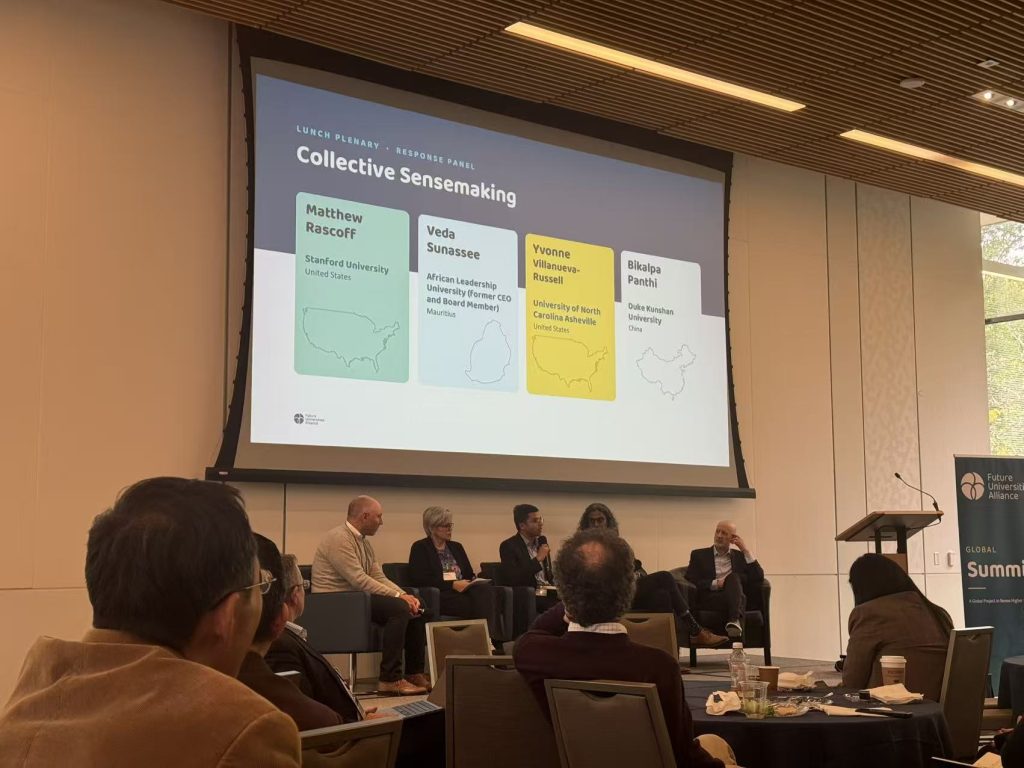
This reflection was written by Bikalpa (Bikki) Panthi, a senior at DKU who recently visited Duke for the Global Summit of Future Universities Alliance.
Is AI going to be the biggest challenge in the field of higher education? Or are we just too focused on the conversations about AI and neglecting other important conversations?
The Future Universities Alliance is an initiative launched by Duke University in January 2026 to support leaders who are building new education institutions and reshaping existing ones. Many of these leaders work on similar problems but rarely get opportunities to come together, so the Alliance connects them across countries and institution types to learn from one another. Its main program is the Innovation Sandbox, a 12-month peer learning cohort that started in July 2026 with 49 institutions from 23 countries. The Global Summit is the Alliance’s annual gathering of Sandbox participants, its advisory team, and invited guests. The first one took place from October 3 to 5, 2026, at Duke University in Durham, North Carolina.
The Global Summit of the Alliance was a special experience, especially at a time when most conversations about higher education focus only on AI. This summit brought in other ideas and the challenges that higher education faces besides the implementation of AI, while still giving AI its place. As a contrast to several other higher education conferences, I found that this approach caught my attention and kept me engaged throughout the summit.
While there are many incubation labs and support systems for new startups, what kind of support is there for new institutions? New institutions have to compete against many giants, whether that is an established university or a ranking system, yet there is no good support system to help them establish themselves. The problems faced by these institutions are the same, or at least similar, but there aren’t many shared spaces where leaders can exchange ideas and help each other solve them. This must be one of the major reasons people call the Alliance the “Y Combinator” for universities. One of the participants also referred to the Alliance as a “Community of Practice,” and this won over many people attending the summit, who couldn’t agree more.
As mentioned during the fireside chat, innovation in higher education is not a new thing. In my opinion, the way different institutions approach it is what makes the difference, and that might come from experience as well as the resources available to the institution. While the competition is severe, there is still a problem of isolation among new institutions. This initiative by Duke University is creating a space for educational institutions and their leaders to bring their best practices to the global stage and have meaningful exchanges with institutions that are in the same situation, or in the situation of their probable future or past.
The summit saw several unique ideas, like “community as curriculum” and a new role of “Chief Workforce Officer” at a university, among others. “Innovation as institutional DNA rather than a side project” was another idea that I found compelling. But it is not always easy to convince an institution or its leadership to adopt a new approach, and this is where several problems were discussed. Among the ones that stood out to me were unstable and stable leadership. While unstable leadership was taken as one of the major issues, the discussion also covered how stable leadership can be an issue too. Where leadership is unstable, the connection between faculty/staff and leadership might not be as strong, especially if staff perceive that the leader will not be there for long. In that case, even if they don’t cooperate much, it won’t be a big issue. With stable leadership, if the leader is rigid in their thinking and not flexible enough to listen to others, it might not look very positive for the future of innovation at the university.
“Change fatigue” was another major issue discussed. Not everyone might be willing to be part of the change, and those who are might not have the same energy to continue after a while. One thing that was mentioned and stuck with me was this: “Loud voices don’t want change and the innovative voices are too soft.” While we talked about loud voices in institutions, we also talked about how an institution might move forward based on a person-dependent view, or based on the location or culture of the institution. Another participant gave the example of a bus and its destination, saying that a passenger should realize in time whether their destination and the bus’s are the same. If not, they have to make a choice: either change the bus or change the destination. These examples resonated deeply with me. It was also mentioned that there should be compensation mechanisms for faculty to ensure they remain willing to be part of the change, so that “change fatigue” is no longer a factor.
The conversation also moved toward engaging more people in institutional change and innovation in education. This is where I saw a special role for myself in the summit. Being one of the few student participants besides the student fellows, I felt a responsibility to advocate for students, who need to be an important part of such conversations. Rather than thinking of students as customers or end users, having them as co-creators is one of the best ways we can innovate in education. I could share my experience from DKU, where we are encouraged to be part of the conversation on campus initiatives. Examples include student feedback on the curriculum redesign of several majors, and the role of students as “student partners” at the Centre for Teaching and Learning, where they contribute to brainstorming as well as to the syllabus and plans for the classes. This made me realize how much my voice is valued at my university and how it could create a greater impact in the community of education leaders. Students can be co-creators, not only end users.
Another major idea brought up was partnerships among the Sandbox participants. Some institutions focused on exchange among students through exchange programs, while others were exploring ways of collaborating at the level of faculty and campus administration. This made me realize that a real exchange between institutions is what we need, rather than signing several long MoUs. The partnership conversation was not limited to institutions. We also talked about partnerships with the workforce and the community. I learned about several models in which students went into communities and were actively involved, so that they developed social skills along with professional skills. When I asked whether industry representatives teach some of the classes, I learned that universities not only did that but also had dedicated programs in which they went into industries themselves or invited people from industries to attend classes. In some cases it was a degree program, and in others a certificate program. There was also the concept of a pivot MBA, which allows people already in the industry to earn an MBA and make career changes. In my opinion, this would be a very sellable idea as well.
The summit was an opportunity to have real-world conversations. We talked about connections like faculty-student-employer and student-community, which are practical needs and conversations we need to have, because the focus of higher education should be not only where it is going but also where students are going in the future. We also discussed whether there is a mismatch between the objectives of institutions and the goals of students, especially in an era when AI has been both disruptive and very productive. One of the things I liked most about this summit is that, unlike many other education conversations, it did not focus only on AI. AI got enough attention, but participants also had enough chance to talk about the other real challenges they face. This was one of the biggest highlights, and it made the summit stand out and feel special in many ways.
We also talked about other challenges faced by universities. Some involve the unions present in educational institutions. Unions can be very helpful in taking initiatives forward, but in some cases they might end up being one of the biggest obstacles. The most common challenge, though, was financial sustainability. I noticed two main ways in which a new institution is started. In one, an investor brings in a large sum of money and asks people to come up with an idea. In the other, people come up with a wonderful, innovative idea but do not have the financial resources. The latter might be the case for many new educational institutions, including a good number of those at the summit. As a student, I didn’t have much to contribute to this conversation.
As a student with a deep interest in education, I found this a great opportunity to learn a lot from education leaders from around the world. It was a privilege to be part of this summit, and especially to share my thoughts during the panel discussion that I took part in on the last day.